Best Practices Analyzer 2008 R2 Download
A big part of my DBA career has centered around identifying and sharing SQL Server DBA all-time practices. There are literally hundreds of different all-time practices, and as you lot might expect, non every best practice applies to every SQL Server environs. That ways, that as a DBA, you lot must evaluate the many commonly accepted best practices and determine which ones best meet your item needs.
For experienced DBAs, identifying best practices, and determining which ones employ to their environments, is mostly an easy chore. Merely for novice or accidental DBAs, this is often a difficult job. What nosotros actually demand is a tool to help novice and adventitious DBAs to quickly evaluate a SQL Server example, and so based on the evaluation, recommend any best practices that should exist implemented for their particular environment. Unfortunately, no such tool exists today, although there are a number of free tools that make an endeavour.
Microsoft offers two dissimilar tools that are supposed to analyze a SQL Server instance and recommend all-time practices. One of these tools is called Microsoft Codename Atlanta. This is a cloud-based service (currently in beta) designed to monitor SQL Server instances and provide recommendations based on a set up of established best practices. I will be evaluating this service in a blog post in the next week or so. The 2d tool offered past Microsoft is called the Microsoft SQL Server 2008 R2 Best Practices Analyzer. This product is available today and can be downloaded gratuitous from Microsoft.
The Microsoft SQL Server 2008 R2 Best Practices Analyzer will work with both SQL Server 2008 and SQL Server 2008 R2. There are unlike versions of this tool for older versions of SQL Server.
If yous take never heard of this gratis tool before, you might exist thinking, wow, this is the answer to all of my issues. Hither'southward a tool that tin can clarify my SQL Server 2008 instance and tell me what best practices I need to implement. While this sounds great in theory, this free tool may be a thwarting to many users. The problem is that is doesn't offer advice on many of the most important best practices, only identifying a small number of potential bug, many of which are rather obscure. In improver, many novice DBAs will not be able to fully sympathize many of the recommendations, which means they may non be able to fully benefit from the tool equally much equally more experienced DBAs can. On the other hand, I don't desire to say that you shouldn't run this tool on your SQL Server instances, as it tin can be useful. Just keep your expectations low.
How to Install the Microsoft SQL Server 2008 R2 Best Practices Analyzer
The commencement step is to visit the Microsoft SQL Server 2008 R2 Best Practices Analyzer spider web folio and read about the tool, learning about the installation pre-requisites. The first selection y'all must brand is to determine if you want to download either the 32-bit or the 64-bit version of the software. Second, if they are not already installed on the SQL Server instances you want to analyze, you lot likewise have have to download and install the following two costless applications earlier installing the Microsoft SQL Server 2008 R2 Best Practices Analyzer.
- PowerShell V2.0: If PowerShell V2.0 is already installed on your SQL Server box, then y'all don't need to download and install it again. Otherwise, it must be downloaded and installed as your commencement step.
- Microsoft Baseline Configuration Analyzer: This tool is essentially a wrapper application for the Microsoft SQL Server 2008 R2 Best Practices Analyzer. In other words, y'all must first download and install this free application, then download and install the Microsoft SQL Server 2008 R2 Best Practices Analyzer. Once both applications are installed, and so the Microsoft SQL Server 2008 R2 Best Practices Analyzer will run inside the context of the Microsoft Baseline Configuration Analyzer. How this works will be demonstrated shortly.
The SQL Server 2008 R2 All-time Practices Analyzer has some known issues. If you run into bug installing it, starting time out by visiting this web page.
Once you have all iii applications installed, you are set to begin using information technology.
Using the Microsoft SQL Server 2008 R2 Best Practices Analyzer
One time information technology is installed, running the tool is unproblematic. Offset, first the Microsoft Baseline Configuration Analyzer. Later on it starts upwardly, you volition see the following screen.

Notice that the offset step is to "Select a Production". This is a drop-down box that allows yous to select the SQL Server 2008 R2 BPA to run. Equally I mentioned earlier, the Microsoft Baseline Configuration Analyzer is a wrapper program, and is where the Microsoft SQL Server 2008 R2 Best Practices Analyzer runs from.
If you want to scan a remote SQL Server instance, then click the "Connect to Another Computer" link, select the instance to scan, and so click on the "Start Scan" link. Otherwise, the scan will be performed on the local SQL Server instance.
After you click on the "Beginning Browse" link, the following screen appears.

Typically, the kickoff ii options above are left blank. If your box has multiple SQL Server instances, so you will need to enter the example name to scan. If yous have a single, default instance, then leave these options blank.
Next, select those SQL Server services that are running on the server that are to exist scanned. If y'all accidently select a service that is non running, then you will get an fault message that the service is non running after the browse completes.
For the SQL Server instance I desire to analyze, I accept selected the SQL Server Engine, the SQL Server Setup, and Integration Services. As yous might have guessed, the Microsoft SQL Server 2008 R2 Best Practices Analyzer merely performs those analyses that you select, as each selection has a different set up of best practices it analyzes. For my example, I but desire three unlike analyses to exist performed.
Once y'all have selected which services to analyze, click the "Commencement Scan" link and the scan volition begin, as shown below.

The browse won't accept very long, and when it is done, you will see a report like to the following screen.

The report has ii tabs. The first tab is "Noncompliant", which is used to list all of the best practices that the tool thinks you have broken. It is divided into both Errors and Warnings. The second tab is "All", which displays not only noncompliant best practices, it lists all of the best practices that were analyzed. Let'southward start with the "Noncompliant" tab by expanding both the Fault and Alert categories, which looks like this.

As you can see, the tool is telling me that the SQL Server example I analyzed has viii Errors and 12 Warnings. While some of the letters are fairly straight-forward, many of them are non. To find out what a detail message means, click on the Mistake or Warning. For example, if I click on the first Error, the following yellow screen appears, which offers a brief explanation of the Error.

As you lot can encounter, the additional information is more useful than the original Fault message, just it doesn't include a lot of detail. To see an fifty-fifty farther detailed explanation, click on the "More Data" link, which opens up a web page with a much better explanation, every bit shown beneath.
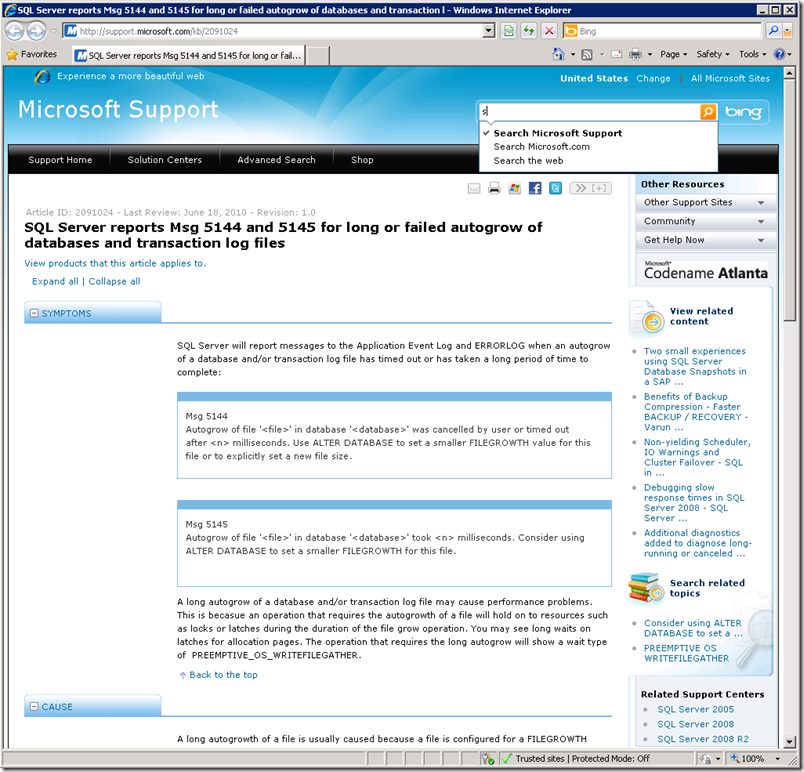
At present, this is much more useful information. Depending on the Mistake or Warning, the web folio yous are directed to tin can be very long and detailed. In virtually cases, I establish the explanations understandable, although many novice DBAs may detect themselves a little hard to understand. The web pages follow a format of Symptoms, Crusade, Resolution, and More than Information.
At this bespeak, your chore would be to review each of the Errors and Warnings provided past the Microsoft SQL Server 2008 R2 Best Practices Analyzer, read each message and related webpage, and based on what you learned, perhaps have action to correct the Error or Warning. I say "maybe" considering not all of the Errors or Warnings may really exist applicable to your state of affairs, or you might not care about the Error or Warnings, choosing to ignore them based on your knowledge of your SQL Server instance.
This focus of this blog postal service is on how to install and run the tool, not to explain each best practice the tool analyzes.
For instance, let's say that afterwards some research, I decide that the"Autogrow Failed or took a long time" Error, the one in my example, is not important to me. I can turn it off by clicking on the "Exclude this Effect" link in the message window, which you see below.

When you exclude any of the Errors or Warnings, a new tab appears on the screen that includes your Exclusions, as you lot see below.

Past excluding Errors or Warnings that you don't care about, you won't see them in the Noncompliant tab, just they will nevertheless announced nether the Exclusions tab. If you want to re-include any of the Errors or Warnings you have excluded, you can re-include them by clicking on them and clicking on the "Include this Consequence" link.
Now that we have had a brief look at the Noncompliant tab, let'due south take a quick look at the All tab,which is shown below.

This tab is interesting considering it lists all of the various best practices that the tool analyzes. Just like with the Errors and Warnings, yous tin click on them to open up the yellow description box, and you tin can also click on the "More Information" link to view the related web page data. Just reading through each of these is an education in and of itself.
At this bespeak, you now know everything there is to know well-nigh using the Microsoft SQL Server 2008 R2 Best Practices Analyzer. On the other hand, the difficult role is determining if a particular Error or Alarm should exist corrected. While the web-based help pages are very useful in explaining them, much of the content is technical and may be across the skill level of many novice and accidental DBAs.
Because of this, my suggestion is that unless you know exactly what a detail Warning or Error message ways, and the implications of making changes to correct them, that yous don't make any changes based strictly on what the tool says. Instead, if yous see a Warning or Error that looks like information technology needs to be corrected, be sure to research it kickoff using other resources, talk to other DBAs, and get their input earlier you begin making any changes. And of course, exist sure that you examination any potential change on a test box earlier making a change on the production box, equally learning by trail and mistake is not a good idea on a product SQL Server.
Although this tool is incomplete in the best practices in analyzes, and often the Errors or Warnings may be hard to decipher past novice DBAs, information technology nevertheless can be a useful tool, and ane that I call back you should cheque into if you accept not done so already.
DOWNLOAD HERE
Posted by: mcnameeplam1978.blogspot.com

